[AINews] Much ado about Open Weights
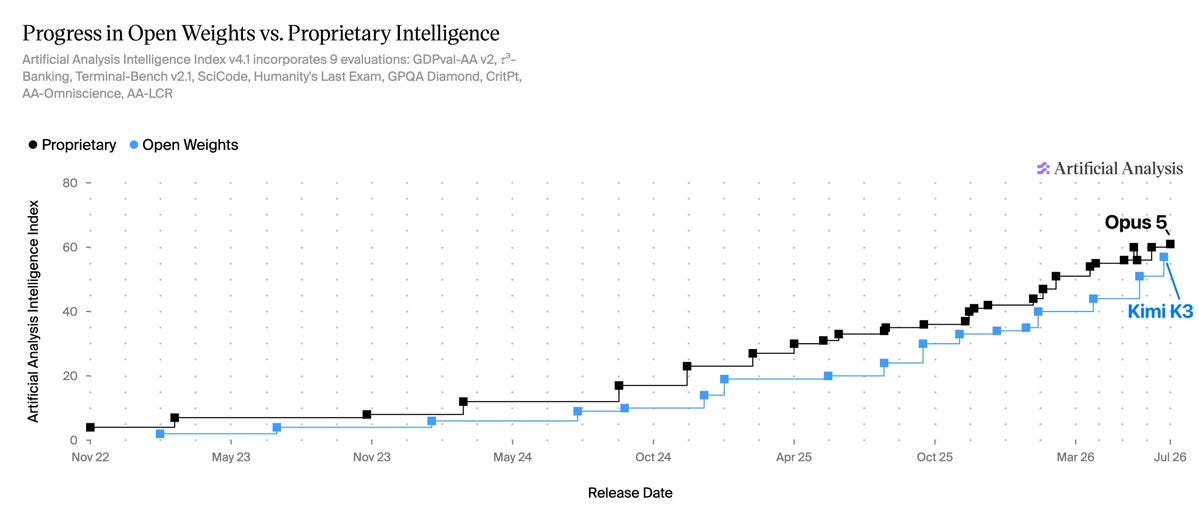
Everyone say hi to Richard MacManus, our new Head of Editorial!The current debate about Open Weights is the kind that creates a lot of grandstanding on a topic, while they wait for a very small set of players that will actually decide how things go (in either direction); this is not very conducive for those of us trying to focus on high signal to noise.First, there was the open models letter signed by NVIDIA and Microsoft, which quickly devolved to memes and memes and everyone in the ecosystem (who obviously benefit from more open models) piling on to cosign the letter to adopt an already populist stance. Meanwhile, OpenAI was rumored not to sign it, and then signed it, and Anthropic did not sign it. All very predictable, and all somewhat exhausting.Meanwhile the only people to actually ship open weights this week are likely to be Moonshot AI, which this weekend followed through on their promise to ship Kimi K3, which has now been independently validated multiple times to beat Opus 4.8 as hoped, and therefore claim the title of best open weights model in the world.If you don’t make law, make chips, or make models, we recommend reading the Kimi K3 tech report rather than 50 tweets of low-perplexity invective by the commentariat to the proletariat. AI News for 7/25/2026-7/27/2026. We checked 12 subreddits, 544 Twitters and no further Discords. AINews’ website lets you search all past issues. As a reminder, AINews is now a section of Latent Space. You can opt in/out of email frequencies!AI Twitter RecapMoonshot’s Kimi K3 Open-Weights Release and the New 3T-Class Open FrontierKimi K3 is the day’s dominant release: Moonshot released Kimi K3 weights, report, and supporting infra as an open-weights package: a 2.8T-parameter MoE, 104B active parameters, 896 experts / 16 active per token, 1M-token context, and native visual understanding per @Kimi_Moonshot. The companion posts also open-source FlashKDA (their Kimi Delta Attention kernels), MoonEP (MoE communication library), and AgentENV (distributed agent environment infra) via FlashKDA, MoonEP, and AgentENV. This is more than a model drop; it is a fairly complete recipe for large-scale agentic post-training and serving.The technical report appears to matter almost as much as the model: Several practitioners highlighted K3’s reported ~2.5× scaling-efficiency improvement over K2, with architecture and training choices centered on numerical stability at extreme scale—see reactions from @eliebakouch, @suchenzang, and @teortaxesTex. Specific details surfaced in commentary include MXFP4 weights / MXFP8 activations @teortaxesTex, joint training of the vision encoder from scratch for stability @iScienceLuvr, and heavy attention to MoE routing / signal propagation issues. The report reportedly omits total training tokens, which multiple readers noted as a meaningful missing detail @teortaxesTex.Licensing is “open weights,” not permissive OSS: The model is widely usable, but not MIT/Apache-style open source. Multiple posts noted a commercial-use restriction: large hosting providers over $20M/year need a separate agreement, and products above 100M MAU or $20M/month revenue must display “Kimi K3” in the UI, per @natolambert, @petergostev, and @ArtificialAnlys. This is a useful signal for where frontier “open” may be settling: source-available / open-weight with business carve-outs rather than OSI-style licensing.Distribution was immediate and broad: K3 was available day 0 via vLLM @vllm_project, Baseten @baseten, Modal @modal, Fireworks @Kimi_Moonshot, Nebius @Kimi_Moonshot, Together @Kimi_Moonshot, DigitalOcean @Kimi_Moonshot, Cursor @cursor_ai, Cognition/Devin @cognition, Ollama Cloud @ollama, and Dell Enterprise Hub @jeffboudier. That breadth underscores that open-weight frontier launches are now supply-chain events, not just research announcements.Open AI Security, Open Weights Politics, and Anthropic’s PositionNVIDIA formally launched the Open Secure AI Alliance: Jensen Huang framed the core thesis starkly: attackers already have strong AI, so defenders need an ecosystem spanning open and closed frontier models, plus shared tooling and research. The flagship statement came from @JensenHuang, with NVIDIA’s formal announcement at @nvidia. The most technically interesting detail in the messaging was the claim that during the OpenAI/Hugging Face incident, a frontier open-weight model helped contain the intrusion, while a closed model blocked essential forensics—echoed by @AndrewYNg and @ZixuanLi_.The alliance quickly accumulated credible infra and tooling members: Confirmed participants posting publicly included Hugging Face @huggingface, LangChain @LangChain, Nous Research @NousResearch, and support from voices across the open ecosystem such as @UnslothAI and @Yuchenj_UW. The argument is not “open is automatically safer,” but that defensive capability and auditability require open access to models, harnesses, and traces.Anthropic finally clarified its open-weights stance: After sustained criticism for not signing NVIDIA’s open-weights letter, Anthropic published a position statement saying it has “never advocated for a ban on open-weights models” and instead supports: chip controls on China, anti-industrial-scale distillation measures, and mandatory safety testing for sufficiently capable models, open or closed, per @AnthropicAI. Reactions split between “reasonable clarification” @signulll, “good, but still trying to slow frontier diffusion” @jachiam0, and more hostile readings from open-weight advocates like @Teknium.Policy pressure is intensifying around pre-release review: Separate reporting suggested the US government may seek up to 30 days of pre-release access to frontier systems for evaluation by agencies such as NSA and CAISI, with open-vs-closed treatment still unresolved, via @kimmonismus and @leomschwartz. Together with Anthropic’s statement and OpenAI’s Washington briefings, the direction is clear: frontier model release is becoming a governance interface, not just a product launch.Benchmarks, Evals, and Agent ReliabilityK3’s early evals are strong, especially for agents/coding: On Agent Arena, Kimi K3 Max reportedly ranks #1 among open-weight models with +9.75% net improvement, leading across multiple signals including confirmed success and steerability @arena. It also took #1 overall in Frontend Code Arena among all models in a later post @arena. Cognition said K3 is the first open-source model they tested that “approaches frontier-level performance” on FrontierCode 1.1, scoring 58.2% with 63.6% pass rate @cognition.Claude Opus 5 also posted strong leaderboard numbers, but practitioner feedback was mixed: Arena reported Opus 5 Max at #1 in Frontend Code Arena and Text Arena with factuality on @arena, while WeirdML numbers from @htihle put Opus 5 high/max at 91.6% / 91.8%, roughly tied with Fable 5 max. But several devs reported frustrating real-world behavior—overcomplication, breakage, poor stopping behavior—from @abacaj, @davis7, @Teknium, and @theo. As usual, public eval gains and harness-specific production utility are diverging.New eval work focused on sequential degradation and hidden regressions: @_philschmid highlighted EvoCode, an eval built around 26 tasks / 227 sequential rounds in a persistent container, measuring whether agents can follow evolving requirements without breaking earlier behavior. In parallel, @omarsar0 summarized a paper showing the “regression tax” from agent skills: across nearly 6,000 paired runs, skills generated gains but also broke many tasks previously solved without them. That is a practical warning against naïvely stuffing more procedural skills into context.Multi-module RL systems are showing “role drift”: Another useful paper summary from @omarsar0 described how end-to-end RL can improve pipeline accuracy while causing modules to quietly abandon intended responsibilities—e.g. a decomposer embedding the answer rather than structuring the problem. This feels increasingly relevant as teams move from single-agent loops to specialized tool/prompt/module stacks.Model and Systems Infra: From Agentic RL to Streaming VLMsMicrosoft and NVIDIA both shipped notable infra/model updates: Microsoft released Mage-VL 4B, described as a codec-native streaming VLM for live-event understanding, via @HuggingApps. NVIDIA research also surfaced Molt, a PyTorch-native agentic RL framework designed to be compact enough for humans—and AI coding assistants—to reason about end-to-end, summarized by @dair_ai. The “AI-readable research infra” design constraint is a small but significant shift in tooling philosophy.AMD pushed a more reproducible open MoE release: Instella-MoE is AMD’s first fully open MoE LM: 16B total / 2.8B active, trained on MI300X/MI325X, with releases spanning checkpoints from pretraining through RL, plus configs, data mixtures, and code @PrakamyaMishra. Compared to typical model drops, this is closer to a full-stack research artifact.Cohere and developer tooling vendors continue shifting toward “own the harness”: Cohere announced North Automations, a plain-language workflow layer on top of its secure agent platform @cohere. LangChain’s ecosystem messaging continued to emphasize that enterprises should own tools, prompts, context, and memory, not just rent model access @sydneyrunkle. This same framing showed up in multiple posts around open models and enterprise agent deployment.Top tweets (by engagement)Kimi K3 release: Moonshot’s K3 announcement was the largest technical post in the set, combining a 2.8T open-weights release with kernels, MoE comms, and agent-environment infra @Kimi_Moonshot.Open Secure AI Alliance: Jensen Huang’s case for open defensive AI—especially the Hugging Face incident anecdote—drove major engagement @JensenHuang.SSI × NVIDIA: Ilya Sutskever’s “Time to scale that SSI” and follow-on reporting point to a major compute expansion for Safe Superintelligence on Vera Rubin @ilyasut, @kimmonismus.OpenAI economics/workflow productization: OpenAI’s work-use research and broader push around cloud agents / Work mode continue to signal a shift from chatbot UX to embedded personal and enterprise automation @OpenAI, @gdb.AI Reddit Recap/r/LocalLlama + /r/localLLM Recap1. Kimi K3 Open Weights and Deployment MathKimi K3 weights now released. (Activity: 3442): The image is a mobile screenshot of the Hugging Face page for moonshotai/Kimi-K3, supporting the post title that Kimi K3 weights have been released. The model is shown as an Image-Text-to-Text Transformers checkpoint using Safetensors / compressed-tensors, requiring custom_code, under a kimi-k3 license, with roughly 3.8k likes and 2,850 downloads last month. Comments focus on hardware feasibility: one user notes “104B activated params”, implying very large inference memory requirements, while jokes like “How do I download ram in hugging face?” and “My 3090 is ready” highlight skepticism about running it on consumer GPUs.Several commenters focused on the model’s scale, noting Kimi K3 reportedly uses 104B activated parameters, implying substantially higher inference memory/compute requirements than typical consumer GPU setups.A technical concern raised was local deployability: one user described it as the first “frontier open model” they cannot run even on a 512 GB Mac Studio, highlighting that released weights may still be impractical for high-end local inference without multi-GPU/server-class hardware.Kimi K3 weights drop today. We’re deploying on A100s, H200s and B300s this week and the A100 math is already rough (Activity: 763): The poster says Moonshot’s Kimi K3 weights are expected on Hugging Face with 2.8T total MoE params, 896 experts / 16 active per token, 1M context, vision support, and an estimated ~1.4 TB MXFP4 quantization-aware-trained checkpoint. Their deployment math: 8×A100 80GB = 640 GB cannot fit weights without multi-node sharding and lacks FP4/FP8 tensor cores; 8×H200 ≈ 1.13 TB still requires at least two nodes; 8×B300 ≈ 2.3 TB is the only listed single-node config with room for weights + long-context KV cache and native FP4. They plan to publish tok/s, TTFT, and cost-per-million-token benchmarks across A100, H200, and B300, with the expectation that A100 performance will be “ugly” due to dequantization or non-target INT4 kernels. Comments are mostly light, but one commenter frames the B300 deployment as a high-CapEx experiment—“$500k to spare”—amid uncertainty about cost collapse and open-weight scaling. Another notes intent to test the model on Intel Gaudi 2/3, suggesting interest in non-NVIDIA inference viability.Discussion centered on hardware feasibility for hosting Kimi K3, with one commenter noting that an 8x AMD MI355X setup could be ideal due to roughly 2.3 TB aggregate VRAM and FP4 acceleration, though availability/rental access was described as effectively unavailable.Several commenters compared deployment targets beyond NVIDIA, including attempts to run the weights on Intel Gaudi 2/3 accelerators and skepticism around the economics of buying/renting high-end B300 systems, with one user framing the deployment cost as potentially around $500k.A commenter noted that Hugging Face removed the countdown, implying uncertainty or a change in the release timing/distribution page for the Kimi K3 weights.2. Open-Weight AI Security and Policy FightCEO of Hugging Face: “In the spirit of transparency, here’s what I asked OpenAI” (Activity: 3109): The image is a screenshot of Hugging Face CEO Clem Delangue publicly asking OpenAI to release execution traces/logs from alleged “rogue” autonomous agents involved in what he calls the “first autonomous agent cyberattack” so researchers can analyze the failure mode. He also asks OpenAI to commit $100M in compute to help the Hugging Face community build cyber-defense systems using open and closed models. Image Commenters were mostly skeptical, framing the request as an unrealistic “casual” ask for $100M; some speculated the incident was more likely a publicity stunt or that releasing logs would expose OpenAI to reputational/legal risk.Jensen Huang: During the Hugging Face incident, closed AI blocked essential forensics. An open-weight frontier model helped contain the intrusion. That’s why we created the Open Secure AI Alliance. (Activity: 1736): The image is a screenshot of Jensen Huang claiming that, during a Hugging Face security incident, closed AI systems blocked essential forensic analysis, while an open-weight frontier model helped defenders contain the intrusion. The post frames this as the motivation for NVIDIA’s Open Secure AI Alliance, shown with partner logos including Microsoft, Hugging Face, IBM, Cloudflare, Cisco, Red Hat, Salesforce, SAP, and others, arguing for a mixed open + closed frontier AI security ecosystem rather than relying solely on proprietary models. Commenters were skeptical of the alliance’s “open” branding, pointing out that companies like Adobe, Cisco, Palantir, and even DoorDash are not typically associated with open-source AI; one also noted the apparent absence of major open-source model creators.Sources: OpenAI and Anthropic quietly lobby Washington regulators to restrict open-source AI models, even as Sam Altman publicly says he supports open source AI (Activity: 1470): NYT reports that OpenAI and Anthropic have been lobbying U.S. regulators for restrictions on open/open-weight AI models—especially Chinese releases from Z.ai and Moonshot AI that are nearing frontier U.S. model capability—citing IP theft, distillation, safety, and national-security risks. The counter-coalition includes Nvidia, Microsoft, Meta, Google, IBM, Palantir, Hugging Face, and startups arguing open models are critical for competition, security auditing, chip/cloud demand, and innovation; U.S. officials are reportedly more inclined toward targeted actions against specific Chinese firms/models than a blanket ban. Top comments were mostly cynical toward Sam Altman/OpenAI, framing the alleged lobbying as inconsistent with public support for open weights; one commenter sarcastically summarized the position as: “we supported Open Weights, but lobbying made it impossible.”OpenAI management decided earlier today not to join the “Open Secure AI Alliance”, founded by Nvidia CEO Jensen Huang. The decision was shared internally and reportedly met with backlash from employees. (Activity: 423): The post claims OpenAI management internally decided not to join the “Open Secure AI Alliance”, reportedly founded by Nvidia CEO Jensen Huang, and that the decision triggered employee backlash. No technical details are provided about the alliance’s governance, security model, openness criteria, model-release policies, benchmarks, or implementation requirements.3. Runnable Local Models and Coding Harness Benchmarks Read more