[AINews] Kimi K3 2.8T-A50B: the largest open model ever released; Opus 4.8-class at Sonnet 5 pricing
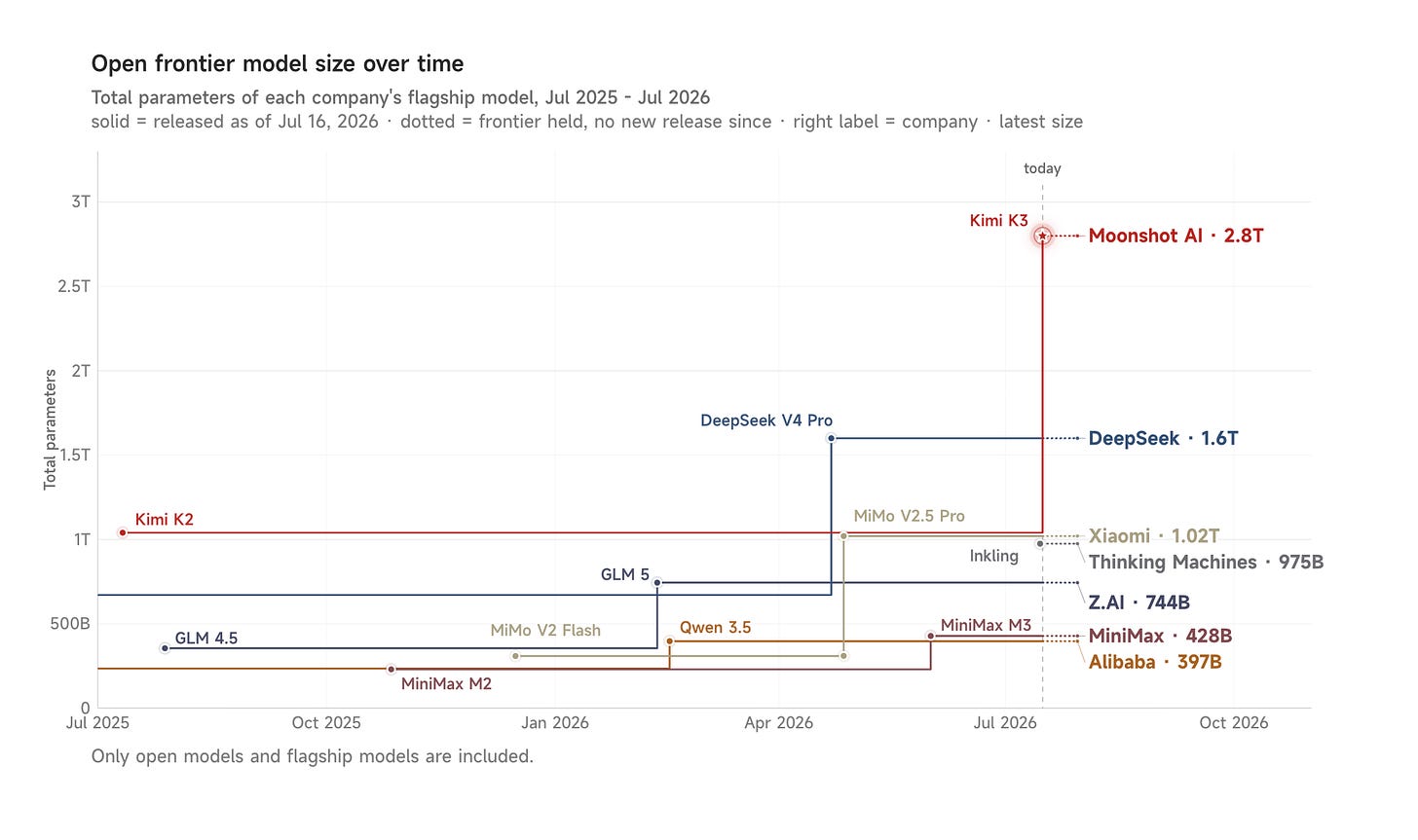
Z.ai GLM has been getting a bit too much love recently, so it’s time for Kimi K3 to fight back! It’s hard to put the scale of today’s open model release in perspective, so thankfully Moonshot AI did it for us:Their vibe reel was entirely edited by Kimi K3 and worth a watch:You can read SimonW and Arena for standard takes and rankings, none of which will be particularly unexpected given the large size of the model, but this pic best summarizes the K2.5 to K3 jump:AI News for 7/15/2026-7/16/2026. We checked 12 subreddits, 544 Twitters and no further Discords. AINews’ website lets you search all past issues. As a reminder, AINews is now a section of Latent Space. You can opt in/out of email frequencies!AI Twitter RecapMoonshot AI launched Kimi K3 as a frontier-class open-weights model, with official claims that place it near top closed models and above prior open competitors.Moonshot officially introduced Kimi K3 as “Open Frontier Intelligence” with 2.8T total parameters, 1M-token context, native multimodal input, Kimi Delta Attention (KDA), and Attention Residuals, and said the model is live on Kimi.com, Kimi Work, Kimi Code, and API, with open weights promised by July 27, 2026 @Kimi_MoonshotMoonshot also highlighted product positioning around long-horizon agentic coding and self-evolving workflows, plus “vision in the loop” coding/game-building workflows that iterate between code and screenshots @Kimi_MoonshotBefore the formal announcement, multiple accounts circulated leaked or app-sourced details that K3 was 2.8T params, calling it the largest open-weight model ever if weights ship as promised @scaling01, @scaling01, @eliebakouchThe official Kimi blog went live later and was widely shared as the primary technical source @Jianlin_S, @scaling01, @Yulun_DuMoonshot’s own phrasing acknowledged a limitation: despite being highly competitive overall, K3 still has a “noticeable gap in user experience” versus Claude Fable 5 and GPT-5.6 Sol @scaling01Arena announced that Kimi K3 entered Agent Arena, plus Text, Vision, Document, and Frontend Code Arena, with community evaluations to follow @arenaArena then reported a major early result: Kimi K3 became #1 in Frontend Code Arena with 1679 points, surpassing Claude Fable 5 and jumping from #18 (K2.6) to #1, ranking #1 in 6 of 7 frontend domains and #2 in Gaming @arenaArena later added that K3 has a 76% pairwise win rate in Frontend Code Arena, versus 63% for Fable 5 and 58% for GPT-5.6 Sol @arenaIn Text Arena, K3 landed at #9 with 1486 points, a jump from #38, with top-10 placements in creative writing, coding, and instruction following, and #1 in several occupation slices @arenaArtificial Analysis published an independent evaluation placing K3 at 57 on the AA Intelligence Index, calling it comparable to Opus 4.8 and GPT-5.5, but still behind Fable 5 and GPT-5.6 Sol overall @ArtificialAnlysAA also reported K3 at 1668 Elo on GDPval v2, 53% / #1 on AutomationBench-AA, and 1547 Elo on AA-Briefcase, with cost per task of $0.94, about 21% fewer output tokens than K2.6 across the full Intelligence Index run @ArtificialAnlysThe launch immediately triggered strong reaction from engineers and model-watchers who framed K3 as an open-model milestone comparable to earlier DeepSeek moments @kimmonismus, @nrehiew_, @eliebakouchTechnical detailsArchitecture and systems detailsOfficial specs: 2.8T total parameters, 1M context, native multimodal input (text + images), text output, open weights by July 27 @Kimi_Moonshot, @ArtificialAnlysK3 uses Kimi Delta Attention (KDA), which Moonshot says enables up to 6.3x faster decoding in million-token contexts @Kimi_MoonshotIt also uses Attention Residuals (AttnRes), claimed to deliver ~25% higher training efficiency at 99% retrieval quality.LiteParse added a gRPC interface for backend document pipelines: LlamaIndex introduced liteparse-grpc, exposing PDF/Office/image parsing, rendering, and OCR-complexity estimation over gRPC with protobuf definitions and generated clients. This is a practical infra improvement for polyglot microservice stacks where REST isn’t ideal.Managed vector/search infra also expanded: Weaviate announced Managed Weaviate on DigitalOcean in public preview, running the unmodified open-source engine (v1.37.1 at launch) with HA, autoscaling, backups, forks, and control-plane observability.Agents, Harnesses, and System Design Becoming the Real Product LayerHarnesses were a recurring theme across builders: Harrison Chase’s conversation with Factory AI’s Eno Reyes was repeatedly shared as a case for why “the harness matters more than the model” (Harrison, LangChain). Chase later argued teams should “own the harness,” “own the context and memory layer,” and “own model optionality” rather than rent intelligence from a single provider (thread).There’s growing interest in open standards for memory and knowledge representation: Harrison Chase promoted OKF (Open Knowledge Format) as an “open standard for memory,” while Brace Sproul detailed OpenWiki’s adoption and the benefits for search, retrieval, and codebase memory.Agent self-improvement and scheduled multi-agent workflows are becoming mainstream topics: @omarsar0 highlighted a survey on self-improving agentic systems, and elsewhere described using an “LLM Council” with recurring scheduled research updates (thread). On the product side, Google AI Studio added a free tier for Managed Agents, plus max_total_tokens for pausing/resuming long runs and native cron triggers.Perplexity’s infra direction was also notable: NVIDIA AI Infra highlighted Perplexity’s new SPACE secure sandbox platform, with early tests on NVIDIA Vera CPU showing up to 1.9× faster sandbox starts—a reminder that sandbox startup latency is now part of agent throughput engineering.OpenAI and Anthropic: Safety, Productization, and Developer Workflow UpdatesOpenAI acknowledged a dangerous Codex/GPT-5.6 failure mode around file deletion: Thomas Sottiaux said OpenAI investigated rare reports where GPT-5.6 unexpectedly deleted files, most commonly when full access mode was enabled without sandboxing or auto review, and when the model attempted to override $HOME for temp directories but mistakenly deleted $HOME itself. OpenAI says it is updating developer messaging, nudging users toward safer permission modes, and adding harness safeguards, with a detailed postmortem forthcoming.OpenAI continued to ship workflow features around Codex and PR review: OpenAI Devs added PR Chat and inline code editing in Codex for reviewing and editing pull requests in context. OpenAI also announced Office Hours around GPT-5.6, ChatGPT, and Codex (source).Anthropic upgraded Claude Code review depth: ClaudeDevs introduced effort levels for /code-review, from low cost/low effort to ultra, where a fleet of reviewer agents reproduces findings independently. Anthropic says low effort beats other code-review tools on findings per token, while high/ultra improve severe-issue recall and reduce false positives.Voice remains a major adoption vector: Sam Altman said he now talks to ChatGPT more than he types, calling the new voice model a threshold-crossing UX shift. Separately, OpenAI published GPT-Live usage limits in its help center, summarized by @athyuttamre: Pro users get unlimited daily usage, while Plus/Go and free tiers have bounded live minutes.Multimodal Video, Real-Time Media, and Creative ToolingGoogle pushed Gemini Omni into Vids: Google and Google Workspace launched Gemini Omni for video generation/editing in Google Vids, plus personal avatars built from a selfie and voice recording. Google says generated clips include SynthID watermarking and that avatars are restricted to a user’s own account/likeness (details).NotebookLM’s rebrand signals tighter Google product integration: Gemini Notebook announced that NotebookLM is now Gemini Notebook, with existing standalone behavior intact but deeper integration coming via the Gemini app and eventually Search. This looks like a packaging/integration move more than a model change.Real-time and agentic media tooling kept advancing: DecartAI introduced Lucy 2.5, a more capable realtime live AI video editor; fal made Lucy 2.5 Realtime available over WebRTC for live video-to-video editing. fal also launched LTX-2.3 Reframe for aspect-ratio conversion with generated scene completion.Meta expanded media model distribution: Meta, AI at Meta, and Alexandr Wang all announced Muse Spark 1.1 on OpenRouter, reflecting continued demand for frontier-ish generative media models via neutral routing layers.Robotics, World Models, and Embodied AIA high-reliability robotics model stood out: Tony Zhao introduced ACT-2 Preview, described as the first robotics model to unify broad generalization with high reliability. The headline claim is striking: a single fine-tuning example can teach Memo a new behavior that generalizes, with zero-shot, real unseen homes, 99% success rate.Reka discussed world-model data operations at production scale: Reka pointed to an episode on how a sub-100-person team prepares petabytes of video data for world model training, emphasizing that the bottleneck is often data platform engineering, not just model architecture.There’s continuing work on embodied world-model architectures: @lixin4ever highlighted a DAMO effort using tri-branch DiT, joint cross-modal attention, and 250M+ RGB frames with dense depth and optical flow annotations to turn a video generation model into a 4D embodied world model.Top Tweets (by engagement)Kimi K3 official release: Moonshot’s launch post was the day’s dominant technical tweet, combining model specs, architecture, and release timeline.Kimi K3 Arena breakthrough: Arena’s Frontend Code Arena #1 post drew exceptional engagement because it framed K3 as not just strong “for open weights,” but directly ahead of a top closed competitor in a visible product task.OpenAI safety incident disclosure: OpenAI’s explanation of GPT-5.6 file deletions was one of the most consequential engineering/safety updates, because it tied model behavior to permission modes, sandboxing, and harness safeguards.Anthropic’s multi-effort code review: Claude Code’s /code-review effort levels is a meaningful productization signal for agentic software engineering: not just “AI review,” but tunable cost/recall tradeoffs and subagent-based verification.AI Reddit Recap/r/LocalLlama + /r/localLLM Recap1. Kimi K3 Launch and Frontier BenchmarksKimi K3 weights to be released on the 27th. (Activity: 399): The announcement image states that Kimi K3 is now available through kimi.com, the Kimi app, Kimi Work desktop client, Kimi Code, and the Kimi API, with the current default “thinking intensity” set to max / extreme. Per the linked official posts (WeChat, English blog), full model weights and additional technical details are scheduled for release by July 27, 2026, which is the main technical significance of the image. Commenters are excited about the open-weight release but expect local inference to be impractical due to the model’s apparent scale, joking that even if someone runs the rumored 2.8T-parameter model on a 24 GB VRAM laptop, it would be at unusably low throughput.Commenters highlight that Kimi K3’s apparent 2.8T-parameter scale makes local inference impractical for nearly all consumer setups; one linked screenshot of the announcement/spec context is here. The discussion frames the weights release as valuable for openness and research even if typical local hardware would be limited to extremely slow or unrealistic runs, e.g. “24 Gb VRAM laptop… 0.01 token per sec.”A technically substantive workflow suggestion was to use Kimi’s largest models for planning/strategy while pairing them with a smaller implementation model, similar to DeepSeek’s large/small model split. One commenter specifically asked for a sub-300B MoE or smaller MoonshotAI model for lighter coding workloads, noting that K2.7 Code appeared to improve over K2.6 and K2.5 for agentic coding use cases.Kimi K3 released on web and app (Activity: 1057): Kimi K3 was announced as available on web/app, with claimed specs of 2.8T parameters and 1M context, and claims of leading performance in coding, agentic tasks, long-horizon reasoning, visual understanding, and agent-swarm workflows (screenshot). No benchmark data, architecture details, license, or Hugging Face/open-weight release link were provided in the post. Commenters focused on deployment practicality: a 2.8T model would be extremely difficult to run locally, with one noting even a 1.58-bit quant likely would not fit in 512 GB RAM. Others questioned whether it would become the largest open-weight model if uploaded to HF and said they were waiting for benchmarks.Discussion focused on the hardware infeasibility of running Kimi K3 locally: commenters cite the reported 2.8T parameter size and note that even a 1.58-bit quantized version would likely exceed 512 GB RAM, putting it far beyond typical consumer or even workstation setups.Several users framed Kimi K3 as potentially one of the largest open-weight models if released on Hugging Face, with interest centered on forthcoming benchmarks. One commenter compared an RTX 6000 Pro 96 GB card against the model’s memory requirements, estimating it is still more than 12x short, underscoring that even high-end single-GPU hardware is not sufficient.Kimi K3 Benchmarks (Activity: 1487): The image is a coding benchmark chart for Kimi K3 (image), comparing it with models such as GPT-5.6 Sol, Fable 5, Opus-4.8, GPT-5.5, and GLM-5.2 across six coding evaluations. Kimi K3 is highlighted in blue and is shown leading Program Bench and SWE Marathon, while placing second on Terminal Bench 2.1, FrontierSWE, and Kimi Code Bench 2.0, suggesting very strong benchmark-level coding performance. Commenters cautioned that the chart only reflects benchmark performance, not real-world usage, but one argued Chinese models appear “not even 6 months behind US models,” perhaps “6 days behind.” Another comment, “2TB VRAM Is All You Need,” appears to be a joke or jab about likely heavy inference hardware requirements.A commenter interprets the shared Kimi K3 benchmark image as evidence that Chinese frontier models are nearly at parity with U.S. models, saying that based on benchmarks alone they appear “not even 6 months behind US models” and possibly closer to “6 days behind”. They explicitly caveat that this is benchmark-only and may not reflect real-world usage quality or reliability.KIMI K3 Beats Claude Fable and GPT 5.6 sol in arena.ai!!! (Activity: 854): The image is a Code Arena WebDev overall leaderboard screenshot (image) dated Jul 16, 2026, showing Moonshot’s kimi-k3 ranked #1 with a score of 1679, ahead of claude-fable-5 and gpt-5.6-sol-xhigh on front-end web development tasks. The post frames this as surprising because Kimi is beating “frontier” models described as “too dangerous” for public release; a commenter notes that on the broader arena.ai text leaderboard, it is not #1 but still appears competitive with gemini-3-pro and gpt-5.6-sol-xhigh. Comments focus on whether this implies China is only “6 days behind the west” and whether kimi-k3 will actually be released as open weights, which would affect its practical significance beyond leaderboard placement.A commenter links the arena.ai text leaderboard (https://arena.ai/leaderboard/text) and notes that Kimi K3 is not leading the main text arena, but is reportedly scoring in the same range as Gemini 3 Pro and GPT 5.6 sol (xhigh), which they consider technically notable for a Chinese model release.There is uncertainty over whether Kimi K3 will be released as open weights, which is a key technical distinction for local deployment, fine-tuning, and reproducibility compared with API-only leaderboard performance.One commenter raises a benchmark-validity concern: if Arena users disproportionately judge models on generated Three.js / 3D browser games, Kimi may have been optimized for that task distribution. They argue this could inflate perceived capability because visually impressive generated games may score well with casual evaluators even if they are not a robust measure of general coding or reasoning ability.Kimi K3 achieves 3rd Place on ArtificalAnalysis, beating out Claude Opus 4.8 (Activity: 656): The image is a technical benchmark chart from Artificial Analysis showing Kimi K3 in 3rd place on the Intelligence Index with a score of 57, narrowly ahead of Claude Opus 4.8 at 56 and behind Claude Fable 5 (60) and GPT-5.6 (59). Commenters add that follow-up charts for cost per task and output tokens per task look “super promising,” but the main technical caveat is whether the model sustains quality in long sessions at roughly Sonnet-like costs and around 30 t/s. The main skepticism is benchmark fatigue: one commenter says they’ve “seen enough bar-charts” and wants real long-session usage reports before accepting the ranking as meaningful.Commenters focused less on the headline rank and more on operational efficiency: one noted that at roughly Claude Sonnet-level pricing and around 30 tokens/s, Kimi K3 would need to show strong long-session reasoning efficiency rather than just benchmark-bar performance. This frames the model’s ArtificialAnalysis placement as needing validation through sustained interactive workloads, not only leaderboard scores.A linked follow-up claimed Kimi K3 looks promising on cost per task and output tokens per task, sharing ArtificialAnalysis-style charts: https://preview.redd.it/ayxi7od6bndh1.png?width=1753&format=png&auto=webp&s=14190215c0ae612463e1d7e9a7587b2d5e0c5b48. The discussion implies Kimi K3’s competitiveness may come from a favorable efficiency/price profile in addition to raw benchmark rank, especially if it is outperforming or approaching models like Claude Opus 4.8. Read more