[AINews] not much happened today
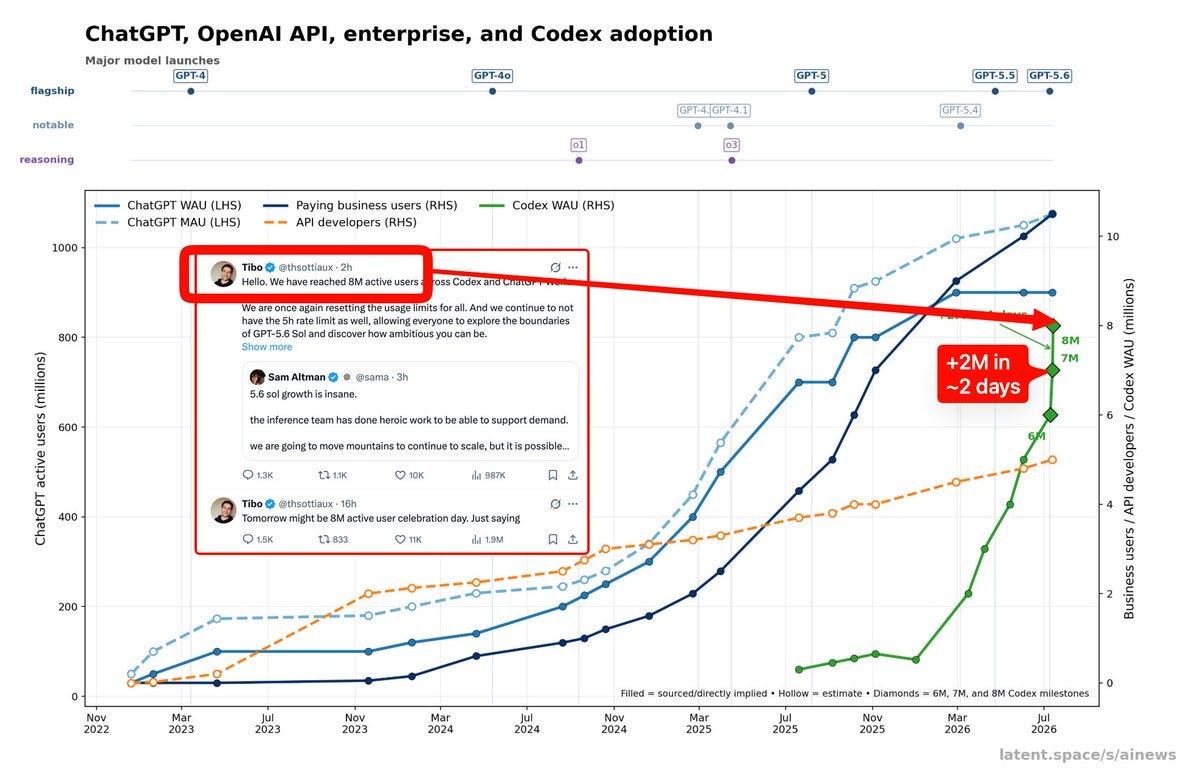
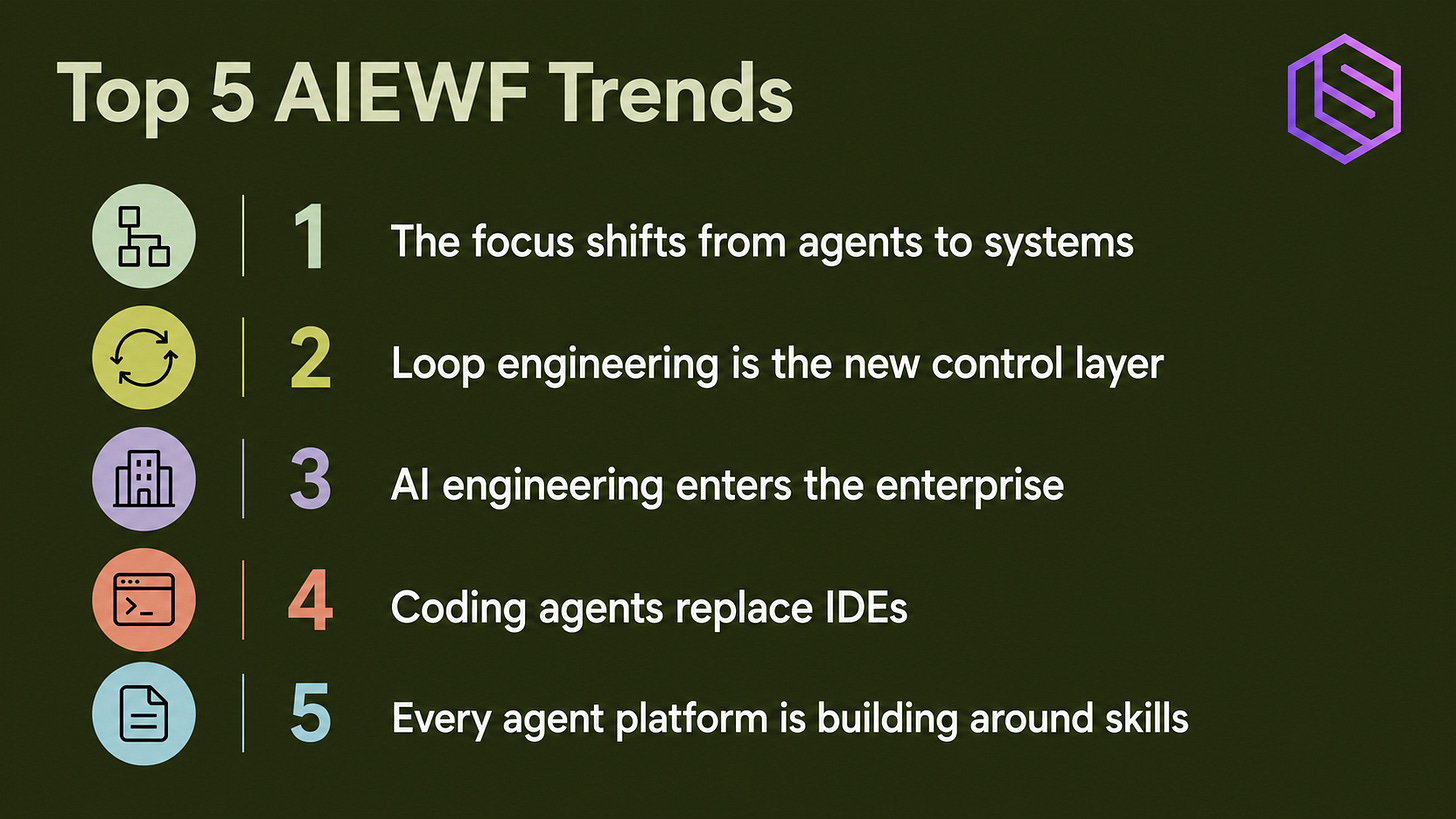
Yesterday’s headline story became even more true, with Superapp usage adding yet another 1M users since we last wrote:In other news, published his final AIEWF26 recap of recaps:Including coverage of Addy Osmani’s excellent keynote covering what AI engineers should continue doing even when the cost of code generation trends to zero:AI News for 7/13/2026-7/14/2026. We checked 12 subreddits, 544 Twitters and no further Discords. AINews’ website lets you search all past issues. As a reminder, AINews is now a section of Latent Space. You can opt in/out of email frequencies!AI Twitter RecapCoding Agents, Harnesses, and the Shift From Chat to ExecutionOpenAI’s agent products are seeing unusually strong pull: @sama said usage of Codex + ChatGPT Work grew 2.5x in a week, later adding that GPT-5.6 Sol demand is “insane” and may cause scaling hiccups while infra catches up (1, 2). The ecosystem response was immediate: JetBrains made Codex its recommended agent, @theo highlighted Codex’s underexposed “question tool”, and OpenAI’s own team showed command-line eval tooling built start-to-finish with GPT-5.6. Product-side, OpenAI also ran multiple usage resets, amplified by @reach_vb and users like @kimmonismus.Harness quality and observability are becoming a first-class differentiator: several tweets converged on the idea that model quality alone is no longer enough. @swyx warned that stale agents.md instructions can act like self-inflicted prompt injection, causing multi-hour stalls in long-running tasks. LangChain added tracing for Codex and later expanded to Cursor, Copilot, Pi, and OpenCode in LangSmith, exposing tool calls, subagents, and token usage. @Teknium shipped Hermes updates to parallelize any subset of tool calls and previously exposed banked resets directly in Hermes Agent. The meta-point was stated crisply by @andykonwinski: companies that can encode their value into evals and environments may gain a more durable edge than those relying on capital or raw scale alone.Open Models, Quantization, and Local Inference CompressionAggressive compression is bringing frontier-adjacent models onto consumer devices: PrismML released Bonsai 27B, based on Qwen 3.6 27B, in two compact variants: Ternary Bonsai 27B at 5.9 GB / 1.71 effective bits and 1-bit Bonsai 27B at 3.9 GB / 1.125 effective bits, both under Apache 2.0. The claim is notable not just for size, but for preserving multimodal, tool-using, long-context agentic workflows locally; a demo shows Hermes running it on an RTX 5090, while Locally AI highlighted phone deployment. In parallel, Tencent Hunyuan released 1-bit and 4-bit Hy3, describing a 295B flagship-scale model that can be served on a single GPU via llama.cpp with MTP enabled.Quantization and edge deployment continue to broaden the open-model operating envelope: @danielhanchen announced NVFP4 dynamic quants across the Gemma-4 family and additional large models including Qwen3.5-122B-A10B and GLM-4.7-Flash. @MiaAI_lab’s DGX Spark thread sketched practical multi-node local deployments, including 1M-context DeepSeek v4 Flash and MiMo-V2.5 on 2× DGX Sparks, and GLM 5.2 NVFP4 across four. The common theme across these posts is that local inference is no longer just a toy path: it is becoming viable for serious agentic workflows, especially when paired with low-bit weight formats and optimized harnesses.Multimodal and World-Model Systems: Video, Realtime VLMs, and MotionRealtime multimodal interaction is moving from “watch then answer” to continuous perception: OpenMOSS released MOSS-VL-Realtime, an 11B vision-language family under Apache 2.0 with 256K context, designed for continuous video streams. Its key systems property is that it can keep watching while generating, revise or interrupt answers as scenes change, and remain silent when evidence is insufficient. A companion technical thread from @Open_MOSS emphasizes a cross-attention architecture, XRoPE for unified temporal-spatial positioning, and unified templates across offline/streaming/realtime settings.Long-video understanding is increasingly framed as active evidence search, not passive frame ingestion: a dense summary from @ZhihuFrontier described OmniAgent, built on Qwen2.5-Omni-7B, which uses an Observation–Thought–Action loop to request only the frames/audio it needs. On LVBench, OmniAgent-7B reportedly scored 50.5, beating Qwen2.5-VL-72B at 47.3, while consuming only ~203 frames vs 768. The training recipe is also notable: passive SFT hurt performance, while 58K agentic trajectories and entropy-weighted RL via TAURA improved it. The larger research pattern here aligns with Andrew Carr’s note that motion is a fundamentally novel data type requiring dedicated collection, infra, and model treatment rather than being reduced to images-with-time.Open world models are inching toward interactive, longer-horizon simulation: @RekaAILabs outlined the data stack behind omni world models, stressing petabytes of video, 6 pipeline stages, and the doubled payoff from data-quality improvements when models both generate and understand video. @omarsar0 summarized LingBot-World 2.0 as one of the first open releases claiming hour-scale, 720p/60fps interactive generation, though still without long-term memory. On the application side, PixVerse Game was highlighted as pursuing the harder problem of real-time interactive video response rather than canned game-like clips.Research Infrastructure, Benchmarks, and Evaluation MethodologyPerplexity open-sourced WANDR, a benchmark for wide-and-deep agentic research: @perplexity_ai described WANDR as a 500-task benchmark built from de-identified production research tasks, requiring 170,495 source-backed records across multiple difficulty tiers. Rather than grading against a static gold set, WANDR re-fetches cited pages and checks claims against underlying evidence, which better matches dynamic web research. @AravSrinivas framed this as the internal benchmark behind Perplexity Computer’s deep-and-wide research harness, while @denisyarats emphasized its additional role as an RL environment synthesized from production traces.Eval design is getting more adversarial and more realistic: Agent Arena highlighted work cutting system costs by 89% while matching the best static config’s accuracy, arguing that full system config > LLM routing alone. Relatedly, Google DeepMind work on model routing argued that routers should be judged not just by accuracy/cost but by behavioral differentiation among experts and stability under paraphrase; otherwise routing may be functionally meaningless. @HamelHusain’s automated evals post landed in a similar place: these systems can spot issues humans miss, but still lack enough domain taste and feedback loops to replace experts.Benchmarks are expanding beyond one-shot SWE tasks toward degradation and search realism: mini-swe-agent marked one year while now powering multiple software benchmarks; SlopCodeBench was cited as measuring how agents erode codebases over sequential tasks rather than just solving one isolated issue. This broadens the benchmark surface from “can it solve a task?” to “can it avoid making the repository worse over time?”Physical AI, Collective Intelligence, and RoboticsSakana AI pushed collective intelligence from software into physical self-repairing systems: across multiple posts, Sakana introduced “Smart Cellular Bricks”, published in Nature Communications. The system consists of many identical cubes, each running a small neural network and communicating only with physical neighbors, yet able to infer global shape and detect damage without centralized control. A follow-up detail is especially notable: the cells can detect missing neighbors across six spatial directions with 95% accuracy and regrow target structures; in simulation, the method scaled to 18,000+ cubes (detail thread).Physical autonomy is also showing up in much smaller form factors: @alextoussss posted a striking demo of an autonomous micro-drone achieving an air-to-air kill of a flying moth, framed as a step toward mosquito eradication. Separately, @fchollet highlighted Airtap, which turns SMS into a headless agentic execution layer for mobile apps, using text as the control plane and intervening only for authentication. These are different ends of the autonomy spectrum, but both point to interfaces where humans specify goals while systems handle embodied or semi-embodied execution.Top tweets (by engagement)OpenAI demand spike and product pull: @sama on GPT-5.6 Sol pricing/efficiency, 2.5x growth in Codex/Work usage, and “5.6 sol growth is insane” were the most consequential operator signals in the set.Governance and lab politics: @BlackHC’s thread on DeepMind’s Pentagon contract and abandoned safeguards and Carole Cadwalladr amplifying it drew very high engagement. In parallel, Demis Hassabis’ AGI governance proposal, endorsed by @mustafasuleyman and @sama, was a major policy discussion node.Notable open-model release: Bonsai 27B stood out as the strongest technically substantive open-model launch in the timeline, due to its combination of 27B scale, phone-class footprint, and Apache 2.0 licensing.AI Reddit Recap/r/LocalLlama + /r/localLLM Recap1. Chinese Open-Weight Models Gain Market Share Read more